
If it feels like everything costs more than it did a few years ago, that is because it does. Groceries, gas, mortgages, insurance, a sandwich at your neighborhood deli — they have all crept up. But the line item climbing fastest on most Buffalo-area utility bills isn’t food or fuel. It’s electricity.
Since the start of 2020, overall consumer prices in the U.S. have risen roughly 25 percent. New York residential electricity rates are up about 48 percent over the same window — and the Public Service Commission just approved another three-year run of National Grid increases on top of that. That single chart, more than any sales pitch, is why a growing number of homeowners in Buffalo, Williamsville, and Amherst are starting to look at solar the way they look at a 401(k) match: not as a feel-good upgrade, but as a financial asset that pays them back, every month, for the next 25 years.
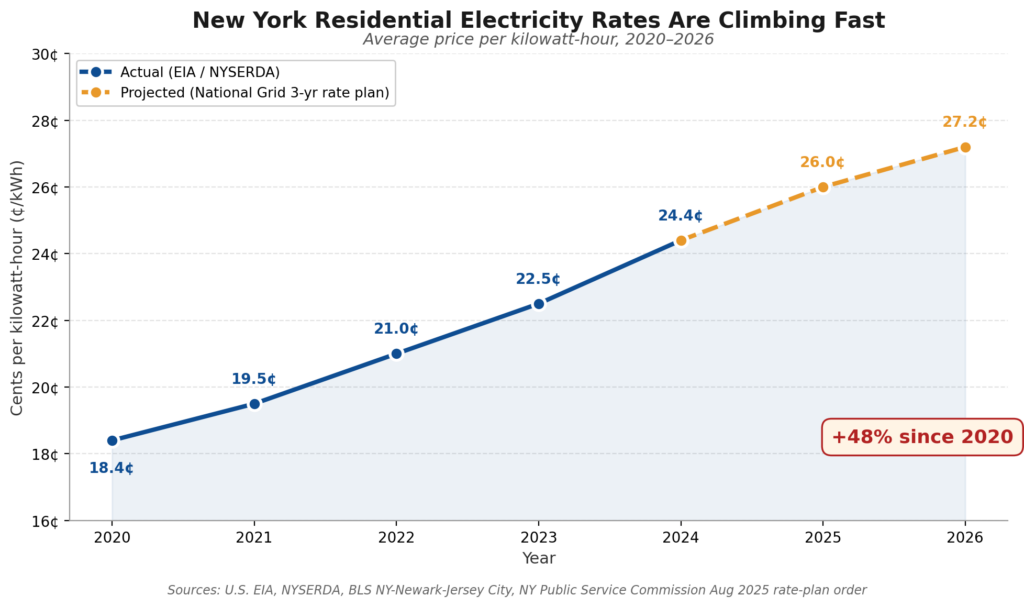
New York residential electricity has gone from 18.4¢/kWh in 2020 to a projected 27.2¢/kWh in 2026 — a 48% jump in six years.
National Grid Bill Savings in Buffalo: The Math Has Quietly Tipped
In August 2025, the New York Public Service Commission unanimously approved a three-year rate plan for National Grid’s upstate electric and gas business. Translation for the average Buffalo household: roughly +$14.32/month in year one, +$6.44 in year two, and +$4.34 in year three on the electric side alone — before any commodity price swings on the supply portion of your bill. By 2028, total electric costs are expected to be about 28 percent higher than they were the day the plan was filed.
That is the backdrop for what we mean by National Grid bill savings in Buffalo. When you install a properly sized solar array on a Buffalo home, every kilowatt-hour your panels produce is a kilowatt-hour you don’t buy from the grid. As National Grid’s rates rise, the value of each of those self-generated kWh rises with them. You aren’t just locking in today’s electricity price — you’re effectively locking in a price that drops over time relative to the alternative.
A Buffalo homeowner offsetting 90% of their bill in 2025 doesn’t just save the 2025 rate. They save the 2026 rate, the 2030 rate, and the 2040 rate — every year, against an electric grid that has only moved in one direction for the better part of a decade.
Solar Panel Payback Period in Williamsville: Where the Numbers Land
A typical Williamsville home installing a 7–10 kW rooftop system in 2026 is looking at a payback period of roughly 6 to 9 years, depending on roof orientation, shading, and how much electricity the household uses. After that point, the system is producing essentially free power for another 15-plus years of warrantied life.
Here is what drives that payback math in Erie County right now:
- NYSERDA-tracked installation costs in Williamsville have stabilized at roughly $2.50–$3.00 per watt installed before incentives — meaningfully cheaper than five years ago.
- New York’s 25% state income tax credit (up to $5,000) on residential solar is still on the books in 2026 and applies dollar-for-dollar against your NY tax liability.
- NYSERDA’s 15-year property-tax exemption on the added home value from solar means your home becomes more valuable without your assessment going up.
- Net-metering / VIBE crediting still allows excess summer production to offset winter consumption.
- Every percentage point National Grid adds to its delivery rate shortens that payback window.
That last point is worth pausing on. A solar panel payback period in Williamsville calculated against 2024 electric rates already looks attractive. Re-run the same model against the rate trajectory through 2028, and the break-even line slides closer by another year — sometimes more.
Home Value Increase from Solar in Amherst: An Asset, Not Just an Upgrade
If you live in Amherst, East Aurora, Orchard Park or any of a number of other local suburbs you already know what your zip code does for resale. Now look at what the data says solar does on top of it.
Two studies anchor the conversation. Zillow analyzed roughly a year of U.S. home sales and found that homes with solar panels sold for an average of 4.1 percent more than comparable homes without — a premium of about $9,300 on the median U.S. home in their dataset, and meaningfully more in higher-priced markets. The U.S. Department of Energy’s Lawrence Berkeley National Laboratory studied 22,000 home sales across eight states and found buyers consistently paid an average of about $4 per watt of installed capacity — roughly $30,000–$44,000 in added value on a typical residential system.
Apply that to a 2,400 sq ft colonial with an 8 kW array and the implication is straightforward: you have not “spent” $25,000 on a roof addition. You have moved $25,000 of household balance sheet from cash into a fixture that lowers your operating costs and shows up on the appraisal when you sell. That is what we mean by home value increase from solar in Amherst and surrounding suburbs— it is one of the very few home-improvement categories that produces measurable monthly cash flow and a documented resale premium. Most kitchens and bathrooms can’t say both.
Solar as Inflation Insurance — Especially Right Now
There is a reason “hedge” keeps showing up in the solar conversation. Almost every other monthly bill a homeowner has is exposed to inflation: groceries, insurance premiums, mortgage interest if they refinance, gas at the pump. Electricity has been one of the most reliably rising of those bills, and there is no public proposal anywhere in New York that points to it going down.
A solar system flips one of those inflationary bills into a fixed asset. The capital cost is incurred once, financed at a fixed interest rate, or paid in cash. The output is denominated in kilowatt-hours, not dollars — meaning its dollar value rises as electricity rates rise. In a stable-rate world, solar is a steady, modest investment. In the world the chart at the top of this article describes, it behaves more like an inflation-protected security with a roof under it.
A Practical Next Step
Every roof is different. The honest answer to “is solar a good financial decision for my house?” requires a real look at your roof orientation, shading, current usage, and tax situation. The good news is that part is free.
National Solar Technologies works with homeowners in Buffalo, Williamsville, Amherst, and across Western New York to put real numbers — not generic estimates — behind the decision. If you would like a no-pressure assessment of your specific payback period and monthly savings at today’s National Grid rates, schedule a free solar consultation or call our Northtowns office directly.
The most expensive electricity you will ever buy is the electricity you buy in 2030. The cheapest is the electricity your roof makes for free.
Sources: U.S. Energy Information Administration (eia.gov); NYSERDA Monthly Average Retail Price of Electricity – Residential; New York Public Service Commission Order on Joint Proposal, August 14, 2025 (Case 24-E-0325); BLS Consumer Price Index, Northeast region; Zillow Research, “Homes With Solar Panels Sell for 4.1% More”; Lawrence Berkeley National Laboratory, “Selling Into the Sun”; NY-Sun Affordable Solar program, NYSERDA.
